Welcome back to the What If? blog, this time it’s a little different… I’m Mike from Huff No More and I’ve orchestrated a not so hostile takeover! You see Joe and I were talking about his upcoming Kickstarter for Word Dungeon and I felt that Joe has conducted so many great interviews with designers and publishers in the blog that it would be great to hear his story.
We’ll be digging into Joe’s journey into game design, from looking at the different ways to create and play to the importance of being able to respond positively to criticism and turn all feedback into steps forward in design. We’ll find out about the humble origin story for Word Dungeon and how the game plays along with Joe’s innovative approaches to engaging and growing his community for the Kickstarter campaign on a shoestring budget – but only if the shoestring itself was free! And we’ll also be finding out Joe’s motivations to begin this very blog and his key takeaways from the many great interviews.
I’m certain every game designer will take a lot from this interview, I know I have!
Mike: Hi Joe, it’s great to be back on the blog, but this time in the interviewer chair! The blog has been fantastic for you to ask some probing questions to many excellent game designers and their design journeys. I’m really excited to find out about yours. So can you give us a bit of background about you and what got you into game design?
Joe: Sure, it’s nice to be answering the questions! I’m Joe and I’ve been designing board games for the last couple of years. It all started when a Board Game Café – Bay Games – opened up in Whitley Bay (go and visit if you’re ever in the North East of England). I started playing more games, and met a few designers, came up with an idea or two and then was hooked!
I just like to play… anything that takes me out of the day to day, and lets me be playful is a win for me.”
I reckon I’ve been designing games for a lot longer though. I volunteer for a charity that runs summer camps for children, and as part of those I’ve been creating and delivering large scale, playful activities for the last 20 years. I just like to play.
Mike: That’s a great place to start and I can really see how your experience in delivering fun activities has that game design feel about it.
I really love your last statement of “I just like to play” and I think that a lot of designers have taken the same leap from their love of play into designing something of their own. It would be great to find out more about the games you love to play. What games got you hooked on the tabletop hobby and are there any mechanics that you particularly enjoy?
Joe: As a kid, I never got much further than monopoly, when I was playing I was more than likely climbing trees, or kicking arse (usually losing) at Smash Bros on the N64. Then at Uni I ended up playing an entire summer’s worth of Catan. Then another, much longer pause. Anything I was playing was stuff that I created, or at least co-created with other wonderful humans on the summer camps that I volunteered on (details here). Then covid came along, and I spent a load of time creating an immersive adventure experience online. We called them facilitated online games.
Covid passed and a new board games café opened in town – Bay Games – and that’s where I dived back into the hobby and into design.
I’m aware that none of that answers your question…
The answer is: anything, I’ll play anything. I might not play it twice, but I’ll give it a go. I don’t care about winning, or about losing. I just love getting lost in a game with a group of people. Suspending disbelief for an hour or two and heading out on an adventure. And those games that really click for me? I don’t think there’s a pattern to them, other than that I’m with other people and we’re all on a shared adventure. In fact, that’s not quite it, because I like playing solo too. So anything that takes me out of the day to day, and lets me be playful is a win for me.
Mike: That’s a great outlook, play can come in so many forms and ways to have fun through play can be really different. I am also a big fan of the experience of playing a game rather than just winning and can take just as much joy watching other people make a great play than doing so myself. Although that is often a difficult concept to teach kids! And there is definitely something about that escapism that play can give and also the social aspect to be shared with other people.
Let’s get a bit more into your game design journey specifically. Can you tell us a bit about your initial game design ideas and how you developed them through playtesting and feedback.
Joe: I think you dive into this industry without knowing very much at all, and assuming that every idea that drops out of your head is going to be a good one. And you quickly learn that’s not the case. The majority of my ideas are terrible. It’s only when you start the process of playtesting that you work that out (although I’m now a little better at spotting my terrible ideas). Through playtesting and feedback I’ve learnt to simplify things, to strip ideas back to work out what’s important or interesting about a concept, and what really isn’t.
The majority of my ideas are terrible. It’s only when you start the process of playtesting that you work that out.
It helps to have a supportive, but critical playtesting group, I have one in Newcastle via PlaytestUK – they’re a wonderful group of people who’ve provided so much support. It’s also good to have other key people to mentor you. I found these all over the place, one (you) I met at my first ever convention. I needed to quickly realise that the expertise I needed to make games was all around and by listening and engaging properly with feedback and critique, that’s where my development would come from. I had a bit of a head start though, my background is in teaching, and we get scrutiny and feedback through that a lot, so I’d already developed my thick skin.
Mike: It sounds like you’ve been able to build a fantastic local group where their experience of design can help you understand design more. I had exactly the same experience with the South London PlaytestUK group so for anyone reading that has just started out in game design, cannot recommend enough finding a local design group to meet up with.
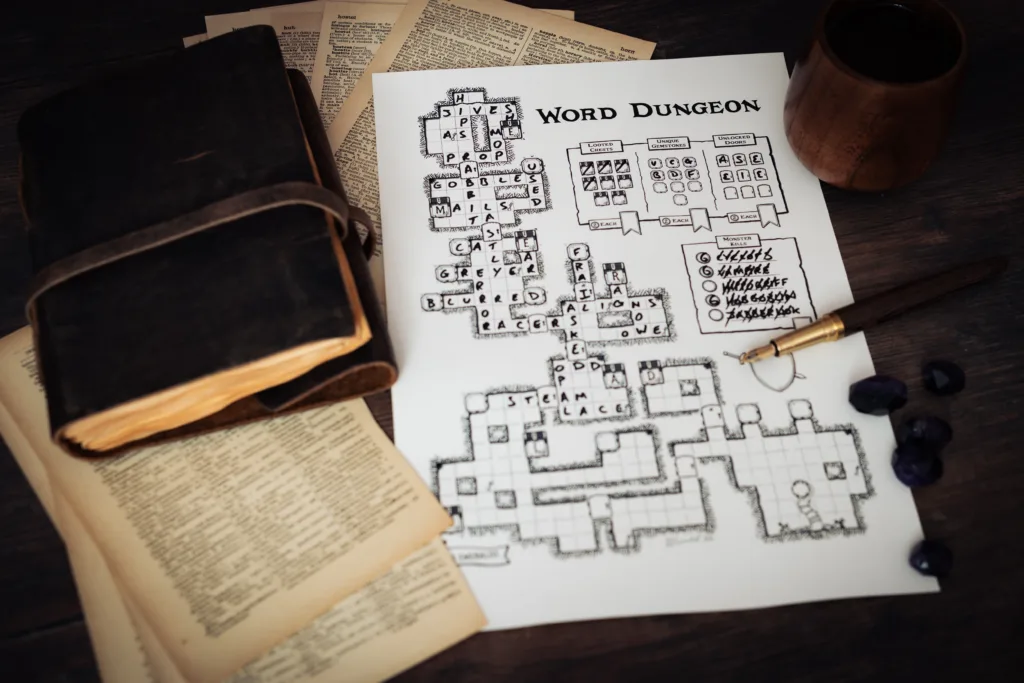
So taking this learning experience, let’s talk about Word Dungeon which is going to be your first game to bring to Kickstarter. I’m a little biased having playtested the early iterations, but it looks like you’ve landed on a really interesting mechanic where you have created fun and engaging word puzzles. How did the idea come about and can you tell us a bit about how you play Word Dungeon?
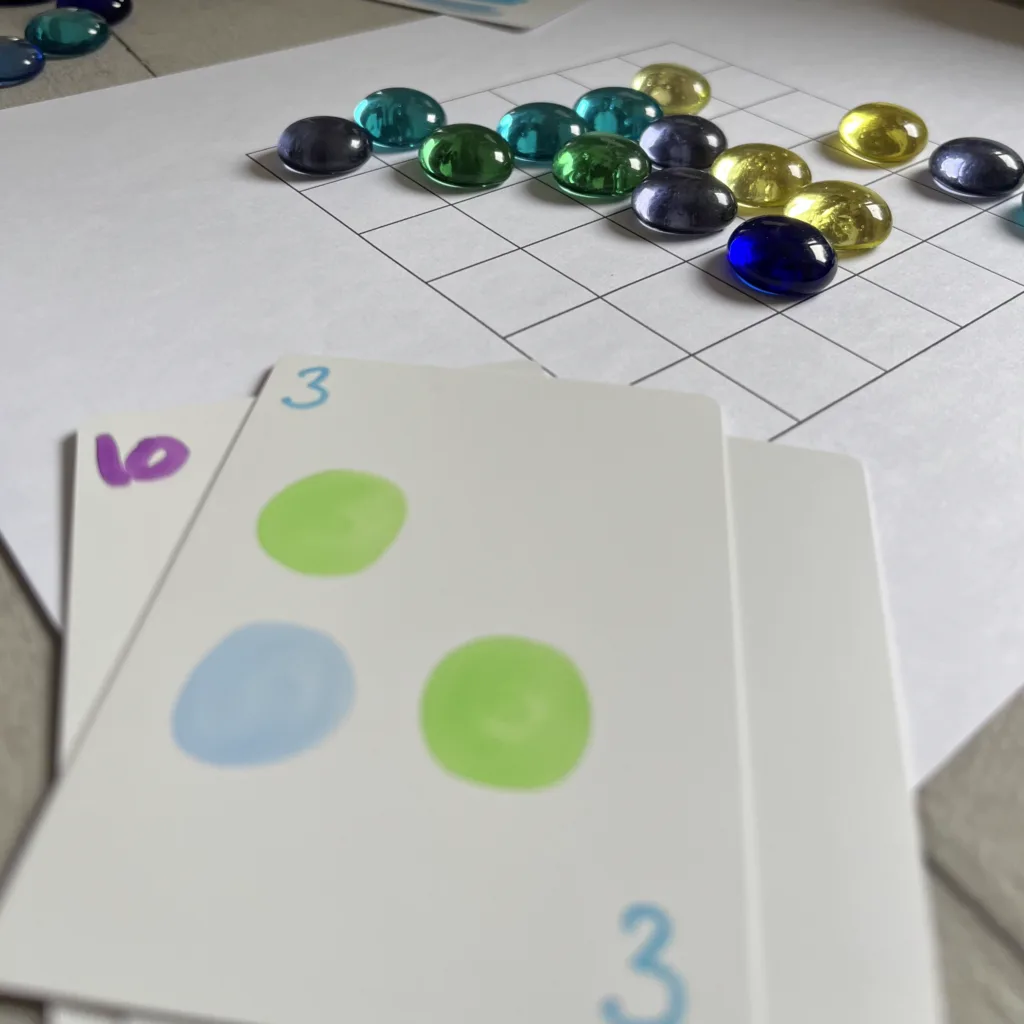
Joe: I wish I had a decent origin story for Word Dungeon, I really do. But sadly the story is lame… I woke up one Saturday morning and a question was in my head “what if you played scrabble in an RPG dungeon format”, about 45 minutes later I had a playable prototype and that was it. Everything else since has been an iteration on that idea, but the core mechanic, that mix of word placement, but with a sense place (a dungeon) remains unchanged.
What if you played scrabble in an RPG dungeon format?
How do you play? At its basic, from a start point to an exit you build a path of interconnected words drawn from your entire vocabulary. Along the way various other mechanics interweave with that core placement, making your grey matter work hard for that exit.
The interplay between word placement, the geographical restrictions created by the map your playing, alongside a few map specific mechanics is all that’s needed to make each dungeon a new adventure. And a replayable one at that.
I know you’re a fan, so I wonder if you might also try to sum it up from a player’s perspective?
Mike: That’s still an awesome moment of innovation to consider putting those two concepts together. Sometimes that creative spark for an idea can just appear and then it all clicks together pretty quickly.
I’m absolutely a fan and incredibly excited for the Kickstarter! What I’ve really enjoyed is that I think you have created a good balance of freedom and constraint in the designs. Where players can play quite casually to complete a Word Dungeon with a great sense of accomplishment, or try to go for all of the points available or even try and use more complex works to self increase difficulty. As a player, I have really enjoyed this flexibility and creates fantastic replayability for me to come back again and again to challenge myself.
Let’s talk about the Kickstarter. This is your first one and I’ve been impressed with some of the approaches to engagement you have had in the build up. Can you tell us a bit about the build up to the campaign, the plan to launch and anything you have up your sleeve for the campaign itself?
Joe: It might help to set the context. This is a kickstart done on a £0 marketing budget. Why? Well part 1 – I don’t have funds to spend on ads; and 2, I’m not sure that even if I did that the returns would be any sort of decent considering this is a PnP game.
So what am I doing? Word Dungeon lends itself really well to a smaller shareable format (Little Word Dungeons), so a lot of promotion is through sharing these on Instagram. I ran a challenge through December and that brought a lot of new prelaunch backers on the Kickstarter prelaunch page. Little dungeons will form a lot of the marketing for the main campaign.
My main strategy for launch is through collaboration. I believe that indie designers working together are able to amplify the reach of their projects. That’s in part what @boardgameprotohype has been doing as a community. But in this campaign I’m being more deliberate about collaboration. Through the 8 day campaign, there’ll be little dungeons that are designed by other indie designers and this will form part of a daily update that offers more dungeon scrawling to backers, but also leverages the audiences of the collaborators, whilst showcasing their projects and building their audience too.
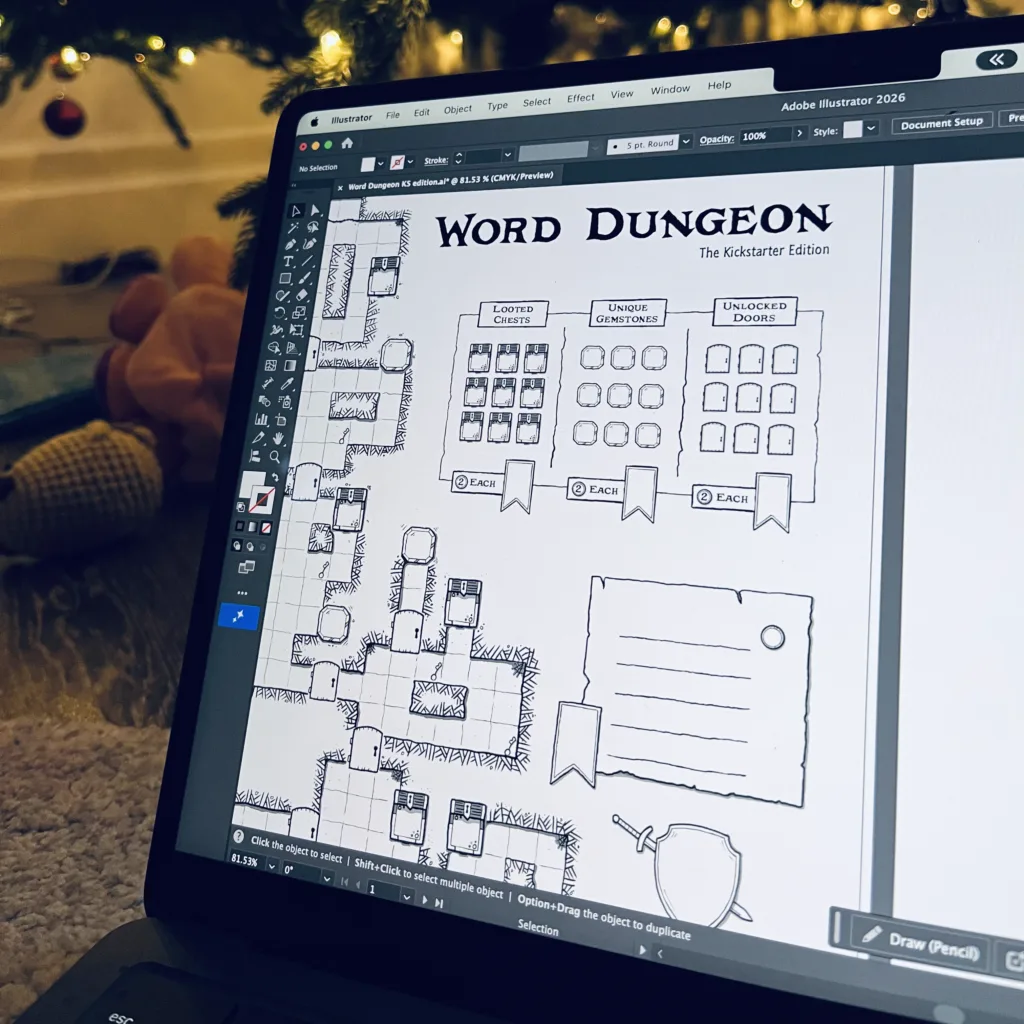
I also have a quirky pledge level that means the base pledge may end up with 6 dungeons instead of 3. Not through stretch goals but through another tier that allows a backer to help design a new map that will become part of the set.
The strategy seems fairly sound and manageable within my budget (£0) and the time I have. Whether it works, well that depends on what I decide is “success” for the campaign. And I’m not sure what my baseline is. Maybe it’d be nice if 50 people backed the game.
Mike: I think often certain limitations can lead to the most creative solutions. In this case, working with a £0 marketing budget means finding new and innovative no cost ways to promote and create engagement with your campaign. It’s been great to see how this strategy has got more people engaged with the project, I had a great time joining in with Festive Challenge!
I think there are a number of lessons here for all indie publishers, where throwing money at ads is not always the way. Creating a way to engage more actively with your community is key to growing interest in a project and you can have a lot of fun on the way!
Okay, one last question for you before we wrap up. You’ve been running the blog for a while now and I’ve really enjoyed reading the many great interviews with a whole host of people involved in game design. What was your motivation to start up the blog and can you share some of your main insights you feel are valuable for game designers?
Joe: The motivation – I jumped into this hobby/profession about 2 years ago, and very quickly realised how little I knew about anything at all. One response to that would be to go for it, run a kickstarter for a game, fail wildly and then learn from the process. There’s merit in that, but I’m at a stage in my life when my time is important to me, and ploughing in a load of hours to learn the lessons that so many have learnt before seems daft.
Don’t do this alone, find a community, or a mentor, get involved wider than your own game.
So I started talking to people about their projects, and the things I was learning felt worthy of sharing, with the hope that it might support other indie designers from throwing time and money into projects that would be riddled with first time mistakes. That’s where the blog came from. I also realised it was a way of championing the voices of indie designers and showcasing their games too.
I think it does one more thing too, for the folk that I’m interviewing I hope that I’m asking questions that help them to articulate their games in new ways, which in turn I think helps them market and share their game wider.
In terms of what I’ve learnt, my main insights? For me it’s a simple 3 things:
- Don’t do this alone, find a community, or a mentor, get involved wider than your own game.
- Slow down. What’s the rush? Where are your deadlines coming from? Slow and steady wins the race.
- Learn to be open to feedback and criticism, if you can’t you’ll make the mistakes that everyone else has made and that could land you with an expensive failure that could have been very different.
Mike: I’m a huge believer in the importance of network, so to find a creative way to expand that through the blog and also share that knowledge more broadly is a great accomplishment. And with the benefit of being able to showcase indie designers and their games too. That to me is demonstrating our community at its best! And for everyone reading, take those last three points down – I couldn’t agree more.
It’s been fantastic talking to you Joe and finding out more about your design journey and Word Dungeon – I’ve learnt a lot and am sure everyone reading has also. You can follow the Word Dungeon Kickstarter prelaunch page here in preparation for the campaign launch on January 30th and the dedicated Word Dungeon instagram page here. Also, make sure to subscribe to the blog if you haven’t done so already.