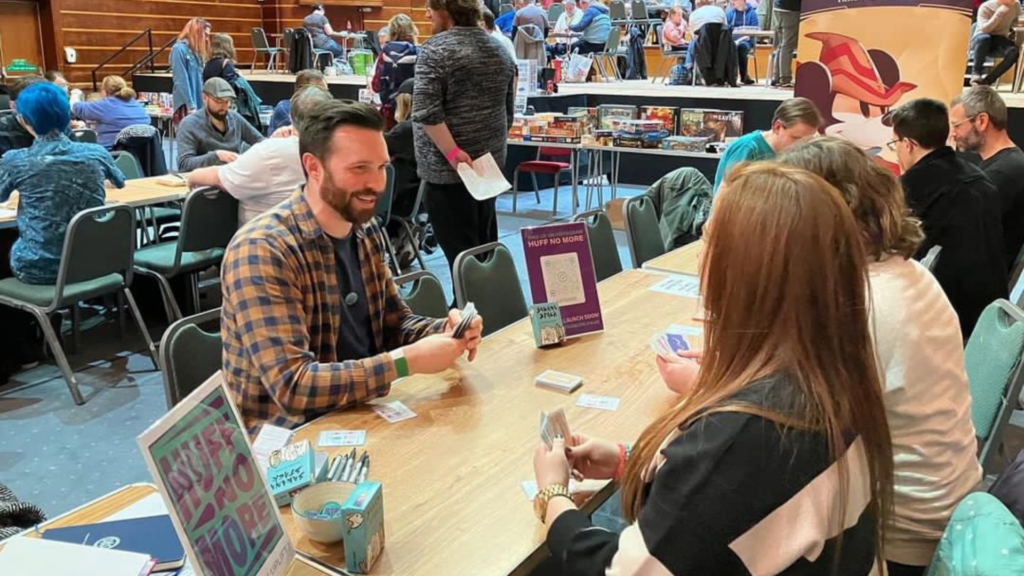
Mike’s back! If you’ve been following the blog, you’ll know Mike from Huff No More as the designer behind Sakana Stack, but today we’re having a proper catch-up about everything that’s happened since their successful Kickstarter campaign. We end up exploring some fascinating territory together – from my rather brutal takeaway that “nobody cares about your game” until you make them care, to Mike’s insights on networking as an introvert and the realities of shifting from creative mode to business mode. You can catch up on previous conversations with Mike here and here.
What I love about conversations like this is how they meander through the real stuff – the mindset changes, the con experiences, the lessons learnt the hard way, and the excitement of new projects on the horizon. Mike’s refreshingly honest about the challenges whilst sharing some brilliant practical strategies that worked for Sakana Stack. Plus, we get a sneak peek at what’s brewing next with Roller Disco.
Settle in and enjoy.
Joe: Heya Mike, welcome back on the blog. Long-time readers will have seen this post, and this post, but for new readers can you introduce yourself and let us know what brings you to games design?
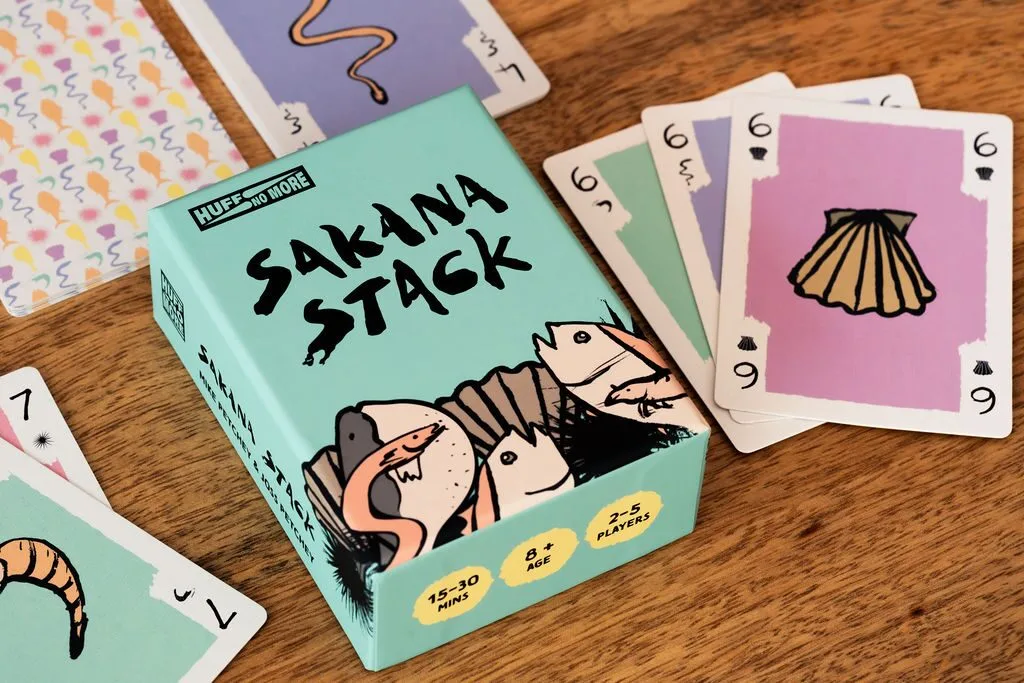
Mike: Hi Joe, it’s great to be back! So I’m Mike, designer of the card game Sakana Stack. I designed the mechanics of Sakana Stack and then my wife Joss produced all of the artwork and graphic design. From there we decided to go down the self-publishing route so set up Huff No More. We wanted to build a business that best represents what is important to us in tabletop gaming, so our ethos is “Create. Play. Uplift.” with a message that creativity and play of any kind is a positive and uplifting experience. We launched Sakana Stack on Kickstarter in October 2024 and had a really successful campaign and have recently finished fulfilment to backers.
It’s been great to follow the blog and read so many incredible insights from designers and publishers you have spoken to. What would you say has been one of the most important points you have learnt from these conversations?
Joe: That’s a good question.
My number one takeaway from all these conversations about Kickstarter and game design is this: fundamentally, nobody cares about your game. That’s a rather harsh statement, but I think it’s true. Your game is your baby. You’ve crafted it over years, maybe even decades. You know the ins and outs of it and it’s incredibly important to you. But to everybody else, it is nothing. It’s perhaps a box with a title, but it’s fairly meaningless. It remains meaningless until you give it meaning to other people, until you’re able to articulate it and share it in a way that means other people suddenly connect with it.
Fundamentally, nobody cares about your game.
But that doesn’t happen by accident. You can’t just make a good thing, particularly in the games world, and expect people will simply enjoy it because the experience of a game happens behind the box. It happens whilst playing it. I think too often we assume that because we’ve made a good thing, everybody else should therefore enjoy that good thing and get it, but they don’t. Nobody cares until you make them care.
I wonder if that resonates with you, and perhaps you could explore how you took Sakana Stack from something you cared about, to something that so many people now love.
Mike: Harsh statement indeed! But it really does resonate. That with all the love and energy that we put into the design of Sakana Stack, we needed to find the right ways to engage with people to bring them on our journey with us. That our game was something they would want in their collection, that they would have a fun experience playing and introducing to people. And that ultimately they saw enough value in these things to buy our game.
I think the first part of that was a realisation that we had to have a complete change in mindset. We had been through such a fulfilling creative experience together which we took a lot of joy from, but now we had to think of our game as a product. The process of building a marketing plan, thinking of target audience and deciding where to spend time and money to promote Sakana Stack in the best way was something we spent a lot of time working on. We had clear milestones to achieve and a timeline as we built up to our Kickstarter launch date.
We had to have a complete change in mindset – now we had to think of our game as a product.
I would say there are three key areas that helped us to drive that engagement and interest in our game:
- Attending lots of cons to demo our game
- Finding the right content creators to help reach a new audience
- Having artwork that had “shelf appeal” and would get people interested
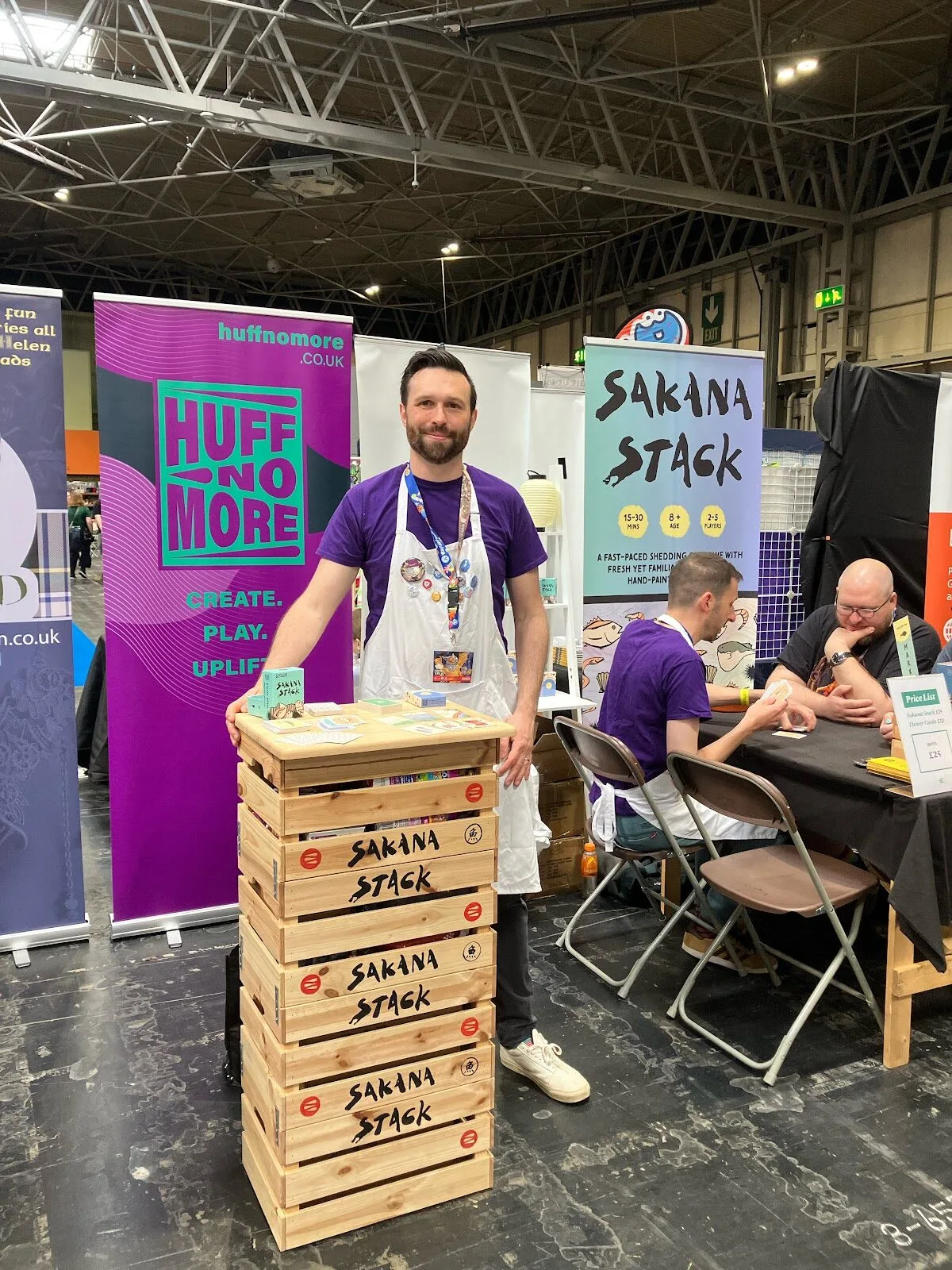
Whilst at times it did really feel like a second job, it was important for me personally to do the thing I enjoy most – play games with people! So hitting lots of cons was very deliberate to help build our audience and share our game with people directly, whilst also personally having a really fun time. In respect of content creators, we were delighted to have interest from so many people whose content we already really enjoyed. For example, I’ve been a big fan of Taylor’s Trick-Taking Table for a long time and bought a lot of games thanks to Taylor’s reviews! So to see our game featured on the channel was personally amazing, but we also knew we were going to reach our target audience for Sakana Stack. And with the artwork it was so amazing to have people head over to our stand at cons and comment that they came over to check out our game because of the artwork. Joss spent a lot of time working through ideas and finessing things so to have people specifically mention how much they enjoy the artwork is amazing for us to hear, but also helps to pique interest in what is in the box.
Speaking of cons, it was great to have you on our stand at UK Games Expo helping demo Sakana Stack! How did you find the experience at UKGE working with us and other indie publishers on stands demoing games?
Joe: Thanks for that detail Mike, those three points are really important and I hope people are furiously taking notes whilst reading them.
To answer your question, working on yours and other members of other BGPH community’s stalls was quite eye-opening and I felt like I learnt so much over the weekend. But there was one insight that really stuck with me.
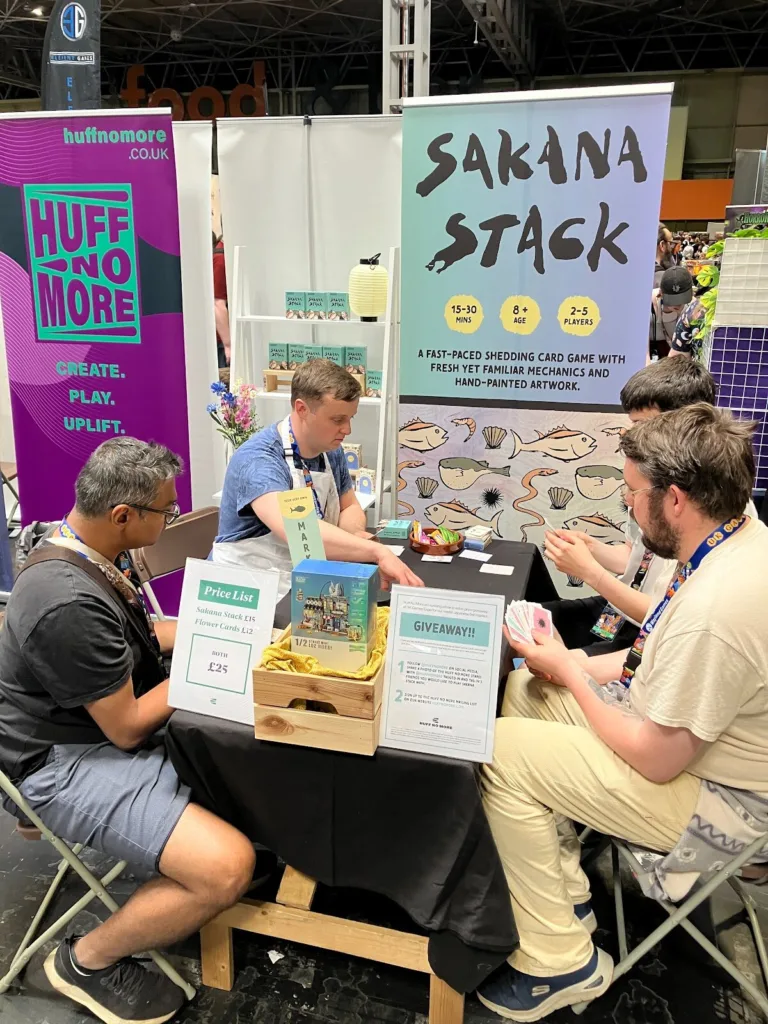
I think, as indie designers, we can sometimes undersell ourselves. I listened to many designers over the weekend pitch their games, either to get people to buy them, or to showcase them for a future crowdfunding project. What struck me was the repeated use of phrases like “In this game we’re trying to…”. So much of our pitch felt almost apologetic – ‘trying’ – like we were second guessing our games, and not bold enough about how great they are and why people should back or buy them.
Now I’m not sure whether this is a British thing, or a games designer thing, or both. But I came away from the weekend deciding that I was going to be much bolder and less self-deprecating about my own games when talking to others about them.
One final thing that struck me, and perhaps we can explore it was your incredible ability to network. You seemingly knew everyone! And had great rapport with many folk. I know that networking and creating those all-important relationships is a key part of your strategy, so tell us how you do it! Does it make you nervous like everyone else? Or do you have some secret sauce that gets you through it?
Mike: I think the confidence about promoting your game could be part of that mindset. If you’re still in a creative mindset you are wanting people to like something you’ve made. If you are in a promotional mindset you should be confident about promoting your game. That’s easier said than done and we have our fair share of imposter syndrome! It was probably only really this UK Games Expo with a successful Kickstarter under our belt that we became more confident in how we spoke about Sakana Stack.
Networking and getting to know our community has been so important to us. We’re so fortunate to have met so many other designers and publishers who have helped us on our journey. But it is really difficult, especially when you are starting out to build your network and having confidence to engage with people. I didn’t sleep the whole week before my first public playtest at Handycon in January 2024! The way I look at my approach to networking is that, yes, I’m promoting a game we’re releasing but I also want to be an active part of the tabletop gaming community.
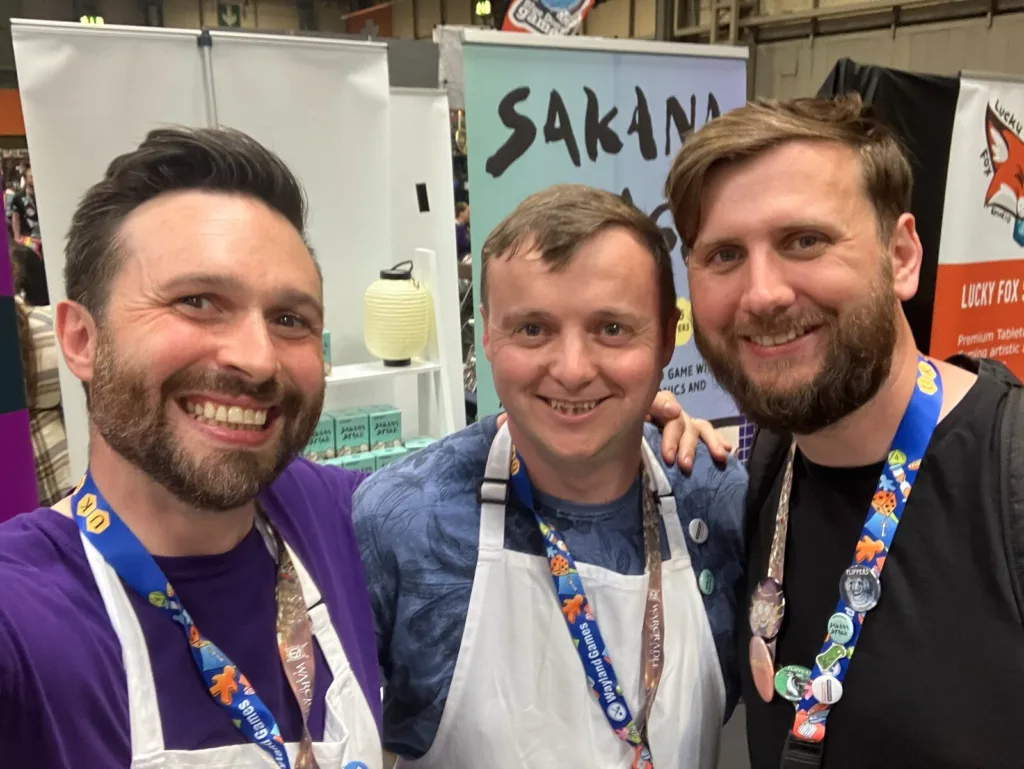
I’m naturally an introvert and often struggle with social situations and have to mentally prepare myself for them. Tabletop games are a fantastic enabler to bridge that social anxiety, by having something tangible that the people you are engaging with are all a part of. Even if just for a short time, such as a few hands of a quick card game. It really takes down those social barriers and helps bring people together. At a con when spending time with like-minded, passionate people I do flip to extrovert as I know I’m surrounded by people with similar interests to me. After UK Games Expo I was like that Homer Simpson meme where he disappears into a hedge after I spent the whole weekend extroverting!
I also try and plan in advance and reach out to people to meet up before events. Being part of groups such as #BoardGameProtoHype is a fantastic way to engage with people online and arrange to meet up, especially at cons. This is true for content creators also. I don’t want the process of us gifting a copy of our game and them creating a review to feel like a transaction. We’ve been lucky enough to meet so many content creators at events, not just to talk about reviewing our games but also just to hang out and play games together. This has been great to build our connections as people, rather than just a publisher behind a game.
How have you found being part of the #BoardGameProtoHype community has impacted your con experiences this year? Especially compared to, say, Airecon 2024 when we first met to Airecon 2025.
Joe: AireCon 2024 seems an age away considering how much things have changed in just over a year.
Honestly, meeting up with members of the @boardgameprotohype community has been one of the best parts of this for me. Knowing that I’m going to walk into a con and find welcoming faces is brilliant, it really takes the nerves away.
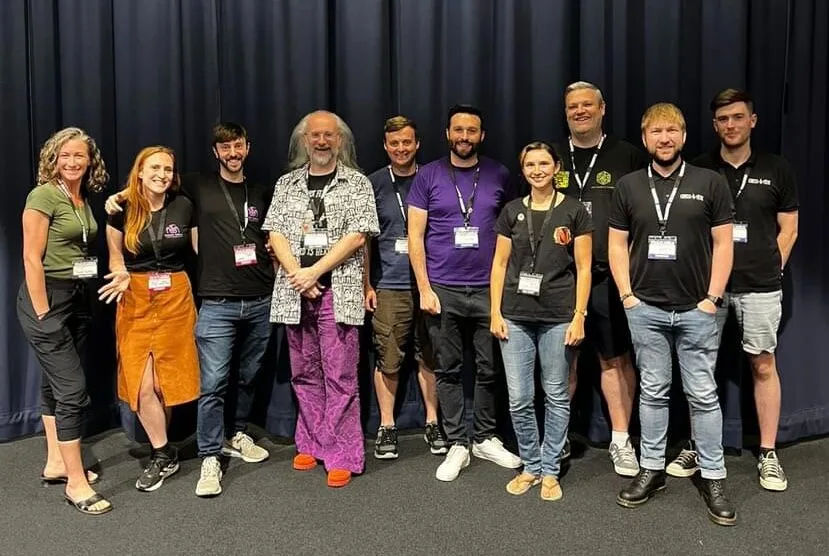
UKGE 2025 was also our first go at trying to actively support people at cons, and I think it went quite well – I certainly enjoyed spending time on the stalls and getting to know our members and their games. I think it’s something we can do a lot more with in future too which is exciting.
I’m going to turn the conversation to your new projects a little now. With Sakana Stack ticked off, how are you transitioning to new projects? And how are you leveraging what you’ve learnt from Sakana stack?
Mike: Every day continues to be a school day and we are always learning! But there are definitely some key things that we feel worked really well we will look to replicate for our next main release. We were happy with how we managed the build up to our Kickstarter campaign and how the campaign went, so we would manage in a very similar way. It also gives us the chance to think differently about the things we would change. The main thing is making sure our rule book is in much better shape before we send out our prototypes. The feedback we got was invaluable to making improvements before we went to print, but we want to do better first time for the next game. We also learnt so much about the manufacturing and fulfilment process, which is invaluable for going into a new project. We’ll be able to budget and plan better and know what manufacturers need to get our games to print.
In respect of next projects, it’s been great to get back to the drawing board with some creative ideas again. As with Sakana Stack, my love of card games has been where I have focused my design efforts. This has included some collaborations with other designers, one being from an impromptu game jam at UKGE with Ben from Travel Games and David Owen where we designed Butt Radio which Ben mentioned in recent blog post with you!
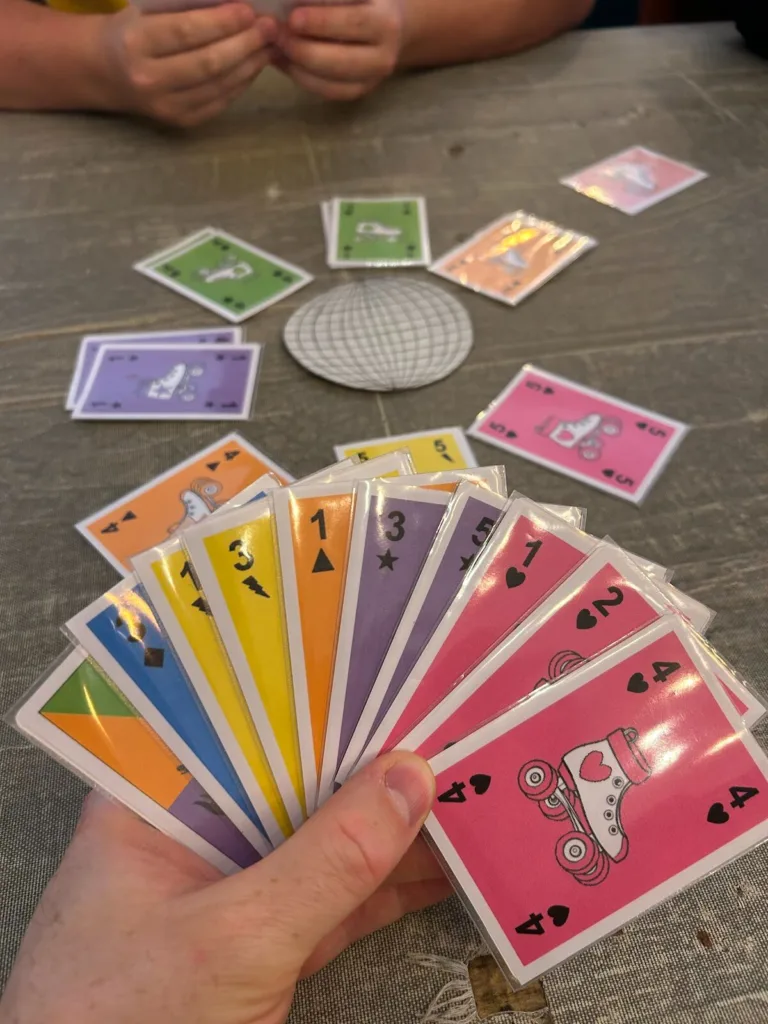
Our main focus now is our next main release at Huff No More which is a game called ‘Roller Disco’. The inspiration came from our daughter’s roller disco birthday party this year and I thought it would be a fun theme for a game. Unlike Sakana Stack, I had the theme first to work with so immediately had the idea of playing cards in a sequence rotating around a mirrorball. After a few solo playtests I was ready to take to Paradice in March for some feedback and it went really well. I also took to Handycon in April and spent a full day playtesting where a few tweaks were made and now I’m really happy with the game and we are into rulebook testing. Joss is currently in the artwork stage so we’re looking forward to the project coming together with a planned launch in early 2026!
At the moment I’m finding inspiration from all kinds of places, which is a fun place to be but a lot of plates to spin turning ideas into designs. Where are you finding inspiration for your own designs currently?
Joe: Everywhere. But particularly at the moment when I’m talking to people about their day jobs. They’ll describe a part of their job and I’ll think, “Hey that’s cool, that’d make a cute mechanic for a game”. I mainly have to stop myself ploughing into an idea though, since we started this blog my Word Dungeon project has come to life, so that’s where my focus is at the moment. Everything else ends up being scrawled as a note somewhere, and hopefully it’ll come in useful later.
Let’s wrap this up, what’s coming up in the next few months for you, what should we look out for and how can we support your projects?
Mike: I’ve had so much fun playing your Word Dungeons and the live audience play-throughs have been great!
So we plan to have Roller Disco artwork ready very soon and then will start to share more widely, along with getting those early preview copies made. We’re so excited to share this game as I feel it is a good step up for me as a designer and for Joss as an artist. The first place to hear about it will be on our mailing list which you can sign up to at www.huffnomore.co.uk and we will be regularly sharing detail on our Instagram. We hope to have a Kickstarter pre-launch page up soon too so keep an eye out for that!
Massive thanks to Mike for taking the time to have this chat – it’s always brilliant to catch up and hear how things are progressing. The honesty about the challenges alongside the genuine excitement for what’s coming next is exactly why I love these conversations. If you want to keep up with Mike and Joss’s journey, definitely sign up to their mailing list at www.huffnomore.co.uk and give them a follow on Instagram. Roller Disco sounds like it’s going to be something special, and I’m looking forward to seeing how it develops.
As always, if this conversation sparked any thoughts or you’ve got your own experiences to share about the topics we covered, drop me a line. Whether it’s about that tricky transition from creative to business mindset, networking as an introvert, or just the general madness of trying to get people to care about your game – I’d love to hear from you. Until next time, keep creating, keep playing, and remember: nobody cares about your game until you make them care!
Oh, and sign up to the mailing list to get more of this in your face!